

Accessing the Georgia business directory requires reliable corporate record information. The Secretary of State Corporations Division maintains public business filings that can be reviewed for entity research. Whether researching a commercial vendor, reviewing business structures, or preparing an independent legal inquiry, accessing available entity filings can support general due diligence. Visitors can use official state resources to review business names, registration details, filing history, and available corporate status information. Reviewing current records can also help researchers identify relevant filings and distinguish between businesses with similar names.
The state repository registers domestic limited liability companies, business corporations, and registered foreign entities operating in Georgia. These public records can provide information about an entity’s registration, formation documents, management details, and current filing status under applicable Georgia law. Researchers can use available records to review corporate information and confirm details maintained by the state. Reviewing current state records is useful for general business research, compliance checks, and due diligence.
How and Where to Search Official Georgia Business Records
Official commercial entity records in Georgia are administered centrally by the Secretary of State Corporations Division in Atlanta. Users can search public corporate filings online directly through the official state eCorp portal or submit requests to the division office. To conduct an official inquiry online, follow these standard verification steps:
- Access the Official Registry: Visit the official Georgia Secretary of State eCorp search portal at ecorp.sos.ga.gov/BusinessSearch.
- Choose Your Search Method: Select your query parameter by Business Name, assigned Georgia Control Number, Officer Name, or Registered Agent Name.
- Enter Search Criteria: Type the keyword or exact legal name. Use the “Contains” filter to locate all active name variations without typing punctuation or suffixes like LLC.
- Review Entity Abstract: Click the matching business name from the search results table to open the full statutory profile and registered agent details.
Core Search Methods for Georgia Commercial Entities
The state database supports several search strategies depending on your preliminary information. Selecting the appropriate search category accelerates public record retrieval and ensures complete coverage of matching entity charters.
| Search Method | Primary Search Input | Best Applied For | Expected Result |
|---|---|---|---|
| Business Name | Legal Entity or Trade Name | Name availability checks and general due diligence | List of all matching domestic and foreign entities |
| Control Number | 7-Digit State Identifier | Exact company record lookup without ambiguity | Direct display of the single matching business abstract |
| Registered Agent | Individual or Corporate Agent Name | Verifying legal representation and process service address | All business entities represented by the designated agent |
| Officer / Principal | Corporate Officer or Manager Name | Investigating executive associations and management rosters | Entities where the individual serves in leadership |
Statutory Public Records Accessible in Georgia
Under the Georgia Open Records Act, public business profiles provide verified data regarding corporate standing and administrative history. Examining these statutory data points protects consumers, investors, and creditors from unauthorized operations. Every official entity profile discloses several primary compliance records:
- Entity Legal Structure: Specifies whether the business is organized as an LLC, Business Corporation, Nonprofit Corporation, or Foreign Entity.
- Statutory Standing Status: Indicates whether the business is Active/Compliance, Active/Noncompliance, Administratively Dissolved, or Terminated.
- Designated Registered Agent: Identifies the statutory agent appointed to accept service of process, lawsuits, and official state notices.
- Filing History & Amendments: Provides chronological records of original Articles, name amendments, annual renewals, and officer updates.
Annual Registration
All registered corporations, LLCs, and limited partnerships must submit an annual registration to the Georgia Secretary of State between January 1 and April 1 each calendar year. This mandatory filing confirms statutory personnel and maintains good corporate standing. Failure to submit annual filings results in statutory late fees and administrative dissolution after sixty days of continued default. Inactive or dissolved entities forfeit statutory liability shields and cannot maintain legal actions in Georgia courts.
Commercial Due Diligence Best Practices
When reviewing corporate records, verify that the legal entity name matches contractual documents exactly. Many commercial enterprises operate under trade names or DBAs that differ from their underlying state charter name. Always verify active standing and registered agent details prior to signing commercial agreements or issuing trade credit.
Commercial Due Diligence Standards for Institutional Transactions
Commercial lenders, corporate underwriters, and institutional investors execute thorough public record audits prior to executing commercial leases, issuing debt facilities, or finalizing corporate acquisitions. A comprehensive entity audit examines whether a commercial enterprise maintains an Active and Compliance status, whether statutory annual renewals have been punctually satisfied, and whether recent officer amendments reflect lawful organizational leadership.
In addition to status verification, commercial legal teams scrutinize historical charter amendments, certificates of conversion, and merger records. These public filings reveal underlying equity changes, successor liabilities, and structural modifications that directly impact the validity of commercial warranties, security interests, and executive indemnification agreements under Georgia commercial law.
- Charter Document Analysis: Confirming the original filing date, corporate duration, and authorized capital structure defined in certified organizational articles.
- Officer and Director Verifications: Ensuring individuals signing loan agreements or commercial conveyances appear as current principals on the latest annual registration.
- Registered Agent Confirmation: Validating that a commercial counterparty maintains a continuous statutory representative authorized to accept binding legal process.
- Administrative Delinquency Checks: Confirming the target enterprise does not appear on state revocation lists or carry outstanding statutory arrears.
Statutory Lifecycles, Revocation Warnings, and Reinstatements
Maintaining active corporate standing requires punctual compliance with statutory calendar deadlines. Under Title 14, every commercial entity must deliver its annual registration between January 1 and April 1. Failing to complete this renewal triggers a statutory late penalty of twenty-five dollars, accompanied by a formal Notice of Delinquency issued to the registered office address.
If an entity remains noncompliant sixty days following service of the delinquency notice, the Secretary of State executes a Certificate of Administrative Dissolution under O.C.G.A. § 14-2-1421. Dissolution strips the entity of authority to conduct commercial business other than winding down its affairs and liquidating corporate assets, exposing business owners to catastrophic personal liability risk on ongoing commercial transactions.
| Operational Lifecycle Stage | Administrative Trigger Event | Legal Authority Status | Remediation Workflow |
|---|---|---|---|
| Active / Compliance | Timely registration and registered agent maintenance | Full legal standing to transact intrastate commerce | Submit routine annual renewals by April 1 |
| Delinquent / Pending Dissolution | Failure to renew by April 1 deadline | Legal capacity preserved subject to late penalties | File overdue registration and satisfy $25 late fee |
| Administratively Dissolved | Delinquency exceeding sixty days after notice | Restricted exclusively to winding down and liquidation | File formal application for reinstatement and pay back fees |
| Voluntarily Terminated | Formal filing of Articles of Dissolution / Termination | Entity formally extinguished from active state registry | Permanent closure or judicial reinstatement under Title 14 |
Public Record Protections
Corporate records held by the Secretary of State are public documents accessible under Georgia transparency statutes. However, prudent organizers must balance mandatory public disclosures against corporate privacy protections. Personal identification details such as Social Security numbers, confidential banking credentials, and private residential telephone lines should never be inserted into publicly filed organizational documents.
Commercial filers frequently utilize professional registered agent services to insulate private home addresses from public disclosure databases. A professional statutory agent maintains a permanent commercial office address in Georgia, receiving legal summons, tax notifications, and official state correspondence during standard business hours while preserving the personal residential privacy of business owners and corporate principals.
Multi-Year Corporate Compliance Management
Corporate managers overseeing extensive commercial portfolios across Georgia frequently balance overlapping statutory compliance obligations across multiple corporate subsidiaries. Managing multiple entities requires systematic oversight of statutory registered agents, timely delivery of annual registrations, and diligent maintenance of registered office addresses under Title 14.
To reduce annual compliance friction, Georgia corporate statutes permit domestic corporations and limited liability companies to file multi-year annual registrations for up to three consecutive calendar operating cycles. Selecting a three-year renewal option locks in current statutory filing fee schedules, protects against administrative oversight, and ensures continuous good standing without annual intervention.
| Entity Entity Architecture | Annual Filing Fee Standard | Three-Year Filing Option | Late Delinquency Penalty |
|---|---|---|---|
| Domestic Limited Liability Company (LLC) | $50 standard electronic filing fee | $150 prepaid multi-year renewal | $25 mandatory administrative penalty |
| Domestic For-Profit Corporation | $50 standard electronic filing fee | $150 prepaid multi-year renewal | $25 mandatory administrative penalty |
| Nonprofit Charitable Corporation | $30 statutory electronic filing fee | $90 prepaid multi-year renewal | $25 mandatory administrative penalty |
| Foreign Commercial Corporation | $50 foreign registration fee | $150 prepaid multi-year renewal | $25 mandatory administrative penalty |
Commercial Real Estate Transactions and Title Underwriting Verifications
In commercial real estate closings and title underwriting, title insurance companies require verified corporate records before issuing title commitments. Commercial conveyances, deeds to secure debt, and corporate easements executed by noncompliant or administratively dissolved entities introduce severe title defects that can cloud commercial real property titles for decades.
Title examiners perform comprehensive entity lookups on the state corporate database to confirm that the selling entity maintained active legal capacity on the exact date of deed conveyance. Furthermore, examiners review certified corporate resolutions and verify that executing officers possessed statutory authority under the entity’s governing Articles of Organization or corporate bylaws.
- Conveyance Authority Confirmation: Cross-referencing executing corporate officers against current state registration dockets to prevent unauthorized conveyances.
- Administrative Dissolution Title Audits: Verifying the grantor entity possessed active legal capacity under O.C.G.A. § 14-2-1421 when delivering real property deeds.
- Corporate Resolution Verification: Reviewing board resolutions and manager approvals required for substantial corporate asset transfers.
- Foreign Grantor Authority Inspection: Ensuring out-of-state entities conveying Georgia real estate hold an active Certificate of Authority.
State Entity Lookup Navigation and Procedural Portal Access
Navigating the official Secretary of State entity database requires understanding the specific query filters available to corporate organizers. To begin a search, visit the official state portal hosted at ecorp.sos.ga.gov. The system provides multiple search parameters, including entity name, business control number, and registered agent.
For complex historical inquiries or expedited in-person document certification, visitors can access the public research counters at the Corporations Division headquarters located at 2 Martin Luther King Jr. Dr. SE, Suite 313 West Tower, Atlanta, GA 30334. You can also contact customer support by telephone at (404) 656-2817.
- Select Exact Search Parameters: Choose between business name, state control number, or registered agent name on the state portal.
- Review Status Designations: Verify that the entity maintains an Active/Compliance standing rather than an administratively dissolved status.
- Inspect Document Filing History: Download stamped PDF images of filed Articles of Organization, amendments, and annual renewals.
- Order Certified Documents: Request official certificates bearing the Great Seal of the State of Georgia for court filings or commercial lending.
Corporate Veil Protection and Risk Allocation Standards
Under Georgia common law, establishing and operating a commercial entity provides an indispensable statutory shield protecting personal household assets from commercial claims. However, judicial authorities across the state strictly enforce statutory formalities codified under Title 14 to preserve this limited liability veil.
Corporate managers must execute formal commercial contracts exclusively in their representative corporate capacities rather than personal names. Documenting key board resolutions, preserving member contribution ledgers, and securing state certificates of existence establishes an unassailable evidentiary record of legitimate corporate governance.
| Corporate Governance Aspect | Statutory Requirement Under O.C.G.A. | Compliance Priority |
|---|---|---|
| Asset Segregation | Complete separation of personal and corporate accounts | Critical for preserving liability veil |
| Signatory Execution | Signing exclusively in representative corporate capacity | Prevents individual signatory liability |
| Annual Renewal Status | Maintaining continuous Active/Compliance standing | Mandatory under O.C.G.A. § 14-2-1622 |
| Registered Agent Service | Continuous statutory agent representation at street office | Required under O.C.G.A. § 14-2-501 |
- Dedicated Banking Accounts: Maintain distinct corporate commercial accounts and never pay personal expenses from business funds.
- Documented Meeting Resolutions: Record annual meetings, organizational minutes, and executive decisions in permanent corporate records.
- Timely Annual Renewals: File mandatory state registration between January 1 and April 1 to avoid statutory late fees.
- Registered Agent Maintenance: Ensure your registered agent street address remains continuously staffed during business hours.
Institutional Due Diligence Protocols for Commercial Creditors
Commercial banking underwriters, institutional financial lenders, and corporate acquisition desks apply rigorous verification protocols before extending trade financing. Querying the Secretary of State corporate registry confirms whether an applicant possesses lawful charter personality, verified corporate standing, and valid executive authority. Underwriters examine historical registration abstracts to detect unannounced ownership transfers, recurring administrative delinquencies, or sudden officer turnover. Discrepancies between formal loan applications and state database filings routinely delay credit decisions and warrant heightened commercial scrutiny under Georgia commercial lending standards.
Prudent commercial creditors also cross-reference state charter filings with county deed registries and Uniform Commercial Code lien abstracts maintained by the Georgia Superior Court Clerks Cooperative Authority. Establishing verified legal identity protects commercial counterparties against insolvency risks and fraudulent commercial misrepresentations.
| Underwriting Verification Standard | Public Record Repository | Commercial Objective |
|---|---|---|
| Entity Legal Existence | Secretary of State eCorp Platform | Confirms lawful legal charter under Title 14 |
| Statutory Good Standing | Official Corporate Profile Abstract | Verifies compliance with state filing mandates |
| Executive Authority Review | Annual Registration Officer Filings | Ensures executing officer possesses binding authority |
| Lien & Encumbrance Clearance | GSCCCA Centralized Lien Database | Identifies perfected security interests and liens |
- Legal Charter Confirmation: Verifying that the applicant exists as a recognized legal entity under Georgia law.
- Filing Fee Compliance: Confirming that annual renewals and statutory franchise fees are fully satisfied.
- Authorized Signatory Clearance: Ensuring that corporate officers executing documents possess verifiable authority.
- County Lien Examination: Performing supplemental searches for personal property liens and court judgments.
Foreign Entity Qualification and Interstate Commerce Compliance
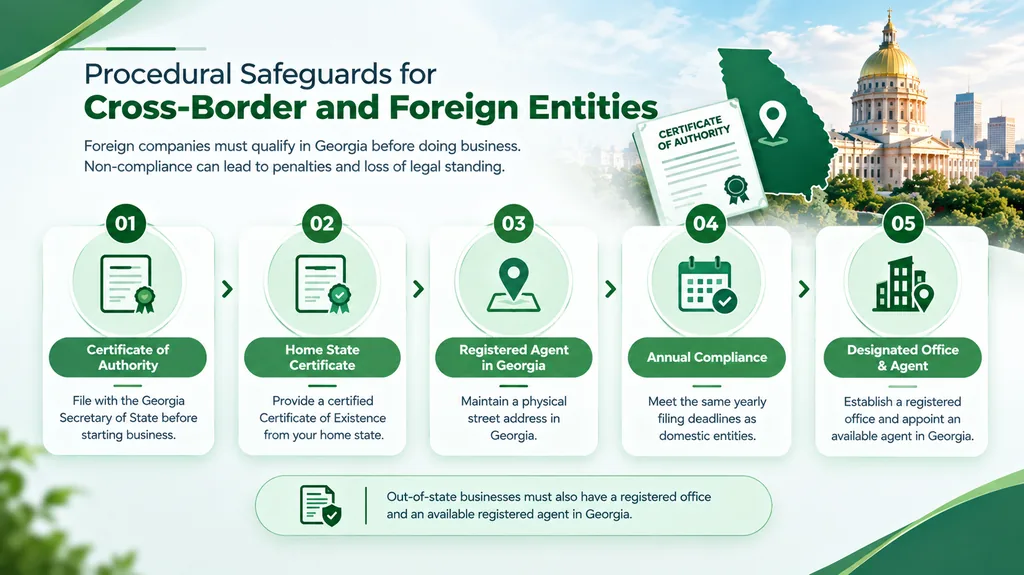
Commercial enterprises originally formed in other jurisdictions (such as Delaware, Florida, or North Carolina) must obtain formal statutory qualification before conducting intrastate commerce in Georgia. Under Title 14 of the Official Code of Georgia Annotated, transacting intrastate commerce without a Certificate of Authority carries substantial statutory penalties.
Foreign entities operating without state approval are statutorily barred from maintaining civil actions in Georgia courts until all back filing fees and late penalties are fully resolved. However, transacting commerce without a state certificate does not impair the validity of contracts or prevent the business from defending civil litigation.
To maintain active foreign qualification, out-of-state enterprises must continuously maintain a registered agent with a physical street office located within Georgia and submit annual renewals in parallel with domestic entities. Understanding these cross-border compliance mandates ensures commercial continuity and protects corporate standing across state lines.
| Foreign Qualification Mandate | Statutory Standard | Consequence of Noncompliance |
|---|---|---|
| Certificate of Authority | Mandatory prior to intrastate commerce | Civil fines and inability to initiate court actions |
| Georgia Registered Agent | Physical street office located in Georgia | Immediate administrative revocation of authority |
| Home State Good Standing | Active charter in state of incorporation | Ineligibility for Georgia foreign qualification |
| Annual Registration Renewal | Filing between January 1 and April 1 | Late assessment penalties and administrative revocation |
- Mandatory Certificate of Authority: Secure official approval from the Secretary of State prior to commencing operations.
- Local Registered Representative: Appoint a reliable statutory agent residing or maintaining offices in Georgia.
- Certificate of Existence Requirement: Submit a certified good standing certificate from your domestic state of formation.
- Continuous Interstate Compliance: Submit annual registrations annually to maintain lawful operational standing.
Statutory Framework of the Georgia Corporate Registry
The Secretary of State Corporations Division maintains the definitive commercial database under Title 14 of the Official Code of Georgia Annotated. Every domestic entity formed within Georgia, as well as foreign corporations transacting intrastate commerce, is legally required to establish and maintain an official charter record. These filings preserve corporate transparency, articulate commercial authority, and ensure adequate notice for stakeholders, consumers, and civil litigators across the state.
Corporate records serve as the evidentiary bedrock for assessing legal standing, identifying authorized officers, and locating statutory representatives designated for service of legal process. Without a centralized state entity registry, commercial contracts, corporate financing arrangements, and judicial notices would face profound administrative friction and heightened litigation risk across both state and federal courts.
| Entity Charter Type | Statutory Authorizing Code | Primary Governing Document | Annual Filing Requirement |
|---|---|---|---|
| Limited Liability Company (LLC) | O.C.G.A. § 14-11-100 et seq. | Articles of Organization | Annual Registration due between Jan 1 and April 1 |
| For-Profit Business Corporation | O.C.G.A. § 14-2-101 et seq. | Articles of Incorporation | Annual Registration due between Jan 1 and April 1 |
| Nonprofit Corporation | O.C.G.A. § 14-3-101 et seq. | Articles of Incorporation | Annual Registration due between Jan 1 and April 1 |
| Limited Partnership (LP/LLLP) | O.C.G.A. § 14-9-100 et seq. | Certificate of Limited Partnership | Annual Registration due between Jan 1 and April 1 |
| Foreign Entity Authorization | O.C.G.A. § 14-2-1501 / § 14-11-701 | Certificate of Authority | Annual Registration due between Jan 1 and April 1 |
Official Search Portals and Physical Office Facilities
To inspect official filings or submit statutory documentation, users utilize the official state registry operated by the Corporations Division. Electronic filings, charter retrievals, and annual renewals are administered through the state online portal at ecorp.sos.ga.gov. The platform supports continuous digital submissions, credit card payment processing, and instantaneous generation of stamped corporate abstracts.
For in-person document review, expedited administrative counter filings, or apostille authentication, visitors can access the official Corporations Division headquarters located at 2 Martin Luther King Jr. Dr. SE, Suite 313 West Tower, Atlanta, GA 30334. Inquiries regarding filing guidelines, corporate record archives, and certified document orders can also be directed to the state customer assistance center by telephone at (404) 656-2817.
Frequently Asked Questions
Verified statutory guidelines and corporate lookup instructions under Georgia Title 14. Clear answers regarding Secretary of State searches, control numbers, and entity compliance.
Is searching Georgia corporate records free to the public?
Yes. Conducting an informational entity search on the official Georgia Secretary of State eCorp database is completely free to the public. Any researcher or corporate organizer can look up corporate legal names, state control numbers, registered agent designations, formation dates, and active compliance standing without remitting any user fees or creating a mandatory paid state account. Accessing these basic public entity abstracts is available twenty-four hours a day for commercial due diligence.
What is a Georgia Control Number?
A Georgia Control Number is an exclusive statutory identification code assigned by the Corporations Division upon formation or registration approval. This seven-to-nine digit numeric identifier links directly to official certified corporate records, annual registration schedules, stamped charter documents, and historical franchise filings preserved under Georgia commercial law. Utilizing the state control number ensures the most accurate lookup results by bypassing similarly named business entities in statewide entity search queries.
Where is the Georgia Secretary of State Corporations Division located?
The Corporations Division headquarters is situated at 2 Martin Luther King Jr. Dr. SE, Suite 313 West Tower, Atlanta, GA 30334. Members of the commercial public can visit the official research counters in person during regular state administrative business hours or contact customer support directly by telephone at (404) 656-2817. State customer support staff assist visitors with certified copy retrievals, expedited document processing, apostille requests, and statutory charter filing procedures.
Can I view business owners on the Georgia search portal?
Georgia corporate abstracts display registered agents, corporate officers, and LLC organizers filed on public state records. However, member lists for manager-managed LLCs and private company shareholders are generally not public records under Title 14 statutes unless voluntarily disclosed within initial articles or recorded annual renewal filings. To inspect confidential equity ownership or internal membership percentages, researchers must typically review private company operating agreements, partnership contracts, or formal discovery proceedings.
What does Administratively Dissolved mean in Georgia?
An administratively dissolved designation indicates that an entity has forfeited its good standing and legal authorization to conduct active commercial business in Georgia. This statutory penalty typically results from failure to submit mandatory annual registrations or maintain a qualified registered agent with the Secretary of State Corporations Division. Dissolved entities lose limited liability protection, cannot enforce commercial contracts in Georgia courts, and must complete formal reinstatement within five years to restore corporate standing.